
Rapid Consulting | MSMEs Subsidy, CLU Services, Statutory Approvals & NOC

Blog

Your blog category

Secure a Business Loan
Blog

How to Secure a Business Loan of Up to 10 Lakh in India

How to Secure a Business Loan of Up to 10 Lakh in India Growing a business demands capital and a business loan can offer the essential financial assistance. In India, business loans are available to entrepreneurs upto 10 lakh via different governmental and private financial organizations. This blog will help you through the eligibility requirements, application procedures, necessary documents, and important aspects of these loans.    Understanding Business Loans in India   What is a Business Loan? A business loan is a financial product designed to help business owners cover operational costs, purchase inventory, invest in equipment, or expand their operations. It can be secured (with collateral) or unsecured (without collateral), depending on the lender’s requirements.   Types of Business Loans i) Term Loans – Fixed repayment & interest rate. ii) Working Capital Loans – Used for daily operational expenses. iii) Government-Backed Loans – Schemes like Pradhan Mantri Mudra Yojana (PMMY). iv) Overdraft Facility – Allows businesses to withdraw more than their account balance. v) Invoice Financing – Based on unpaid invoices of customers. vi) Equipment Financing – For purchasing machinery and tools. vii) Business Credit Cards – Revolving credit for business expenses.   Eligibility Criteria for a Rs. 10 Lakh Business Loan Each financial institution has its own eligibility criteria. However, the general requirements include i) The applicant should be an Indian citizen. ii) Business must be at least one year old with consistent revenue. iii) A minimum credit score of 650+. iv) Stable income proof and bank statements. v) Proper business registration documents. vi) No previous loan defaults. vii) Positive cash flow and turnover requirements.   Documents Required To apply for a business loan, you need the following i) KYC Documents – Aadhaar Card, PAN Card, Voter ID. ii) Business Proof – GST Registration, Shop Act License, Udyam Registration. iii) Financial Documents – Bank statements for the last six months, ITR returns. iv) Collateral (if applicable) – Property papers, fixed deposits, etc. v) Business Plan – Some lenders may require a solid business proposal.   How to Apply for a Business Loan of Up to Rs. 10 Lakh   Step 1: Determine Your Loan Requirement Before applying, calculate the amount required based on your business needs.   Step 2: Research and Compare Lenders Compare interest rates, processing fees and eligibility criteria from banks and NBFCs.   Step 3: Choose the Right Loan Scheme If you are looking for government backed loans, Pradhan Mantri Mudra Yojana (PMMY) offers financing for small businesses.   Step 4: Submit Your Application Apply online via loan websites.   Step 5: Verification and Approval Once submitted, the lender verifies your documents and credit worthiness before sanctioning the loan.   Step 6: Disbursal of Funds After approval, funds are credited directly to your business account.   Interest Rates and Repayment Time Interest rates vary based on lender policies, credit score, and loan time. Generally, interest rates range from 9% to 24% per annum with repayment time between 12 months to 60 months.   Benefits of a Business Loan i) Quick Approval: Instant loan approvals from NBFCs and digital lenders. ii) Minimal Documentation: Paperless application and online verification. iii) Flexible Repayment: Choose EMI plans that suit your business cash flow. iv) No Collateral: Avoids the risk of losing assets. v) Boosts Business Growth: Helps in scaling operations and expansion. Government Schemes Offering Business Loans Up to 10 Lakh   1) Pradhan Mantri Mudra Yojana (PMMY) Provides loans up to Rs. 10 lakh. PMMY Official Website   2) Stand-Up India Scheme Aims to fund SC/ST and women entrepreneurs with loans starting from Rs. 10 lakh to Rs. 1 crore. StartUp India Scheme   3) CGTMSE Scheme Provides collateral free loans to MSMEs with a guarantee cover by the Credit Guarantee Fund Trust for Micro and Small Enterprises (CGTMSE). CGTMSE Scheme   Why You Need the Best Business Consultant in India for Loan Approval Getting a business loan can be a complex process, and expert guidance can make it easy. The best business consultant in India helps streamline your loan application, ensuring that you meet all eligibility requirements.   Frequently Asked Questions (FAQs)   1) Am I eligible to apply for a business loan with a low credit score? Yes, but the interest rates will be higher, and the lender may ask for collateral.   2) How long does it take to get a business loan approved? It depends on the lender. Banks may take 5-10 working days, while NBFCs and fintech lenders can approve loans within 24-48 hours.   3) What is the minimum turnover required to get a business loan? It varies by lender, but most financial institutions require a minimum turnover of Rs. 10-20 lakh per annum.   4) Do government-backed loans require collateral? Most government schemes like Mudra Loan and CGTMSE provide collateral-free loans for MSMEs.   5) What is the maximum repayment tenure for a Rs. 10 lakh business loan? The repayment tenure typically ranges between 1 to 5 years, depending on the lender.   6) Can a startup apply for a business loan? Yes, many lenders offer business loans specifically for startups, provided they meet the eligibility criteria.   7) Can I prepay my business loan? Yes, most lenders allow prepayment, but some may charge a foreclosure fee.   Conclusion Securing a business loan of up to Rs. 10 lakh can easily boost your business growth. By understanding the loan options, eligibility, and documentation, you can choose the best financing solution for your needs. Whether you opt for government-backed schemes or private financial institutions, having the best business consultant in India by your side ensures a smooth and successful loan application process.

Professional Tax and TDS
Blog

Difference Between Professional Tax and TDS: Benefits & Implications in 2025

Introduction Taxation is essential within India’s financial framework, guaranteeing that both businesses and individuals contribute equitably to the economy. Two prevalent types of tax deductions relevant to employees and businesses are Professional Tax and Tax Deducted at Source (TDS). Although both serve unique functions, grasping their differences and advantages is crucial for adherence and financial strategy.This piece, offered by Rapid Consulting, will explain these two tax forms and their benefits in 2025.  What does Professional Tax mean? Professional Tax is a tax levied at the state level by individual state governments on individuals who have income from salaries, businesses, or professions like lawyers, doctors, chartered accountants, and others. The employer deducts this tax and remits it to the state government.   Key Features i) Imposed by state authorities. ii) Relevant to individuals with salaries and professionals. iii) The upper boundary set at ₹2,500 each year. iv) Employers are accountable for withholding and submitting it.  What is TDS (Tax Deducted at Source)? TDS is a mechanism in which a portion of income is with held during payment by the payer and sent to the Central Government. This deduction applies to salary, interest, commission, rental income, and more.   Key Featuresi) Required by the Income Tax Act, 1961. ii) Gathered by the Central Government. iii) Guarantees prompt tax collection and helps avoid tax evasion. iv) The rates differ based on the kind of income (for instance, 10% on professional earnings, 1% on real estate deals).   Key Differences Between Professional Tax and TDS Feature Professional Tax TDS Authority State Government Central Government Applicability Salaried & Professionals Any individual / entity making payments Deduction Monthly At the time of payment Limit Capped at ₹2,500 annually No limit, varies based on transaction type Filing Frequency Monthly / Annually Quarterly / Annually Purpose Revenue for state government Prevents tax evasion and ensures upfront collection Benefits of Professional Tax For Employees & Professionals i) Limited financial impact (₹2,500 maximum per year). ii) Deductible as a commercial expense according to the Income Tax Act. iii) Adhering to state-specific guidelines is straightforward.   For Employers & Businesses i) Guarantees adherence to laws and prevents fines. ii) Standardized deductions streamline financial record-keeping. iii) Aids in the development and infrastructure of the state. Benefits of TDS For Individuals & Employees i) Prevents large tax payments at the conclusion of the fiscal year. ii) Aids in upholding tax compliance. iii) TDS deductions are reflected in Form 26AS and Income Tax Returns (ITR).   For Businesses & Organizations i) Minimizes tax evasion and guarantees prompt tax payments. ii) Functions as a prepaid tax system, simplifying financial planning. iii) Failing to comply results in penalties, increasing accountability for businesses. Compliance and Government Regulations Tax Compliance for Professionals i) States such as Maharashtra, Karnataka, West Bengal, Andhra Pradesh, and Tamil Nadu require the payment of professional tax. ii) Employers are required to register and secure a Professional Tax Registration Certificate (PTRC) along with a Professional Tax Enrolment Certificate (PTEC). iii) Monthly or yearly filings are determined by the state.   Learn More: Maharashtra Government – Professional Tax   TDS Compliance i) Companies are required to subtract and deposit TDS each month and submit quarterly TDS returns. ii) Form 16 (for employees) and Form 16A (for other types of payments) must be provided to those from whom tax is deducted. iii) Late payments suffers interest and penalties as per Section 201(1A) of the Income Tax Act.   Learn More: Income Tax Department – TDS Conclusion  Both Professional Tax and TDS are essential components of India’s taxation framework. Although Professional Tax is a state mandated fee for workers and those receiving salaries, TDS is a national system that guarantees tax collection at the origin. The advantages and regulatory obligations of both taxes is crucial for individuals and companies. For professional consultant, contact Rapid Consulting and guarantee smooth tax compliance in 2025 !

Government Grants for Business Development
Blog

Government Grants for Business Development in 2025 | Funding & Subsidies

The Significance of Grants in Business Achievement For companies aiming to innovate, grow, and support economic development, grants are an important source of funding. Grants are a very appealing funding alternative because they don’t need to be repaid, unlike loans. Government and nonprofit groups have increased grant distributions in 2025 to support companies in a range of industries, from sustainability to technology. Knowing and obtaining the appropriate grants can be key for companies looking to expand or start new initiatives. Rapid Consulting is available to help companies find the grants and subsidies they need to expand. Key Sectors Benefiting from Business Grants in 2025 1) Micro, Small, and Medium Enterprises (MSMEs) & Startups The Indian economy’s backbone is the MSME sector. To assist entrepreneurs and small enterprises, the government is expanding financial assistance in 2025. i) MSME Digital Transformation Grants: These grants help companies implement automation, cloud computing, and AI. ii) The Stand-Up India Program, which assists startups from underrepresented groups, such as female entrepreneurs. iii) Pradhan Mantri Mudra Yojana: Provides MSMEs with ways to obtain low-interest financing. MSMEs & Startup   2) Green & Renewable Energy Businesses Businesses working on sustainability projects, eco-friendly manufacturing, and renewable energy will get a lot of support as climate change initiatives gain traction. i) National Green Energy Fund: Funding for new ventures in solar, wind, and biofuels. ii) Waste Management & Recycling Grants: Promoting the adoption of circular economy ideas by companies. MNRE Gov   3) Technology & Innovation Grants The Indian government is giving the biotech, blockchain, and artificial intelligence technology revolution top priority.  i) Technology Development Board (TDB) grants are one type of grant that helps with the commercialization of cutting-edge innovations. ii) TIDE 2.0 Grants: Capital for blockchain, AI, and IoT startups. iii) Startup India Seed Fund Scheme: This program provides funding to early-stage tech companies. Start Up India Government   4) Healthcare & Biotechnology Following the pandemic, healthcare innovation has grown significantly, resulting in grants for medical research, vaccine development, and healthcare businesses. i) Biotech Ignition Grant: Funding biotech research in its infancy. ii) Healthcare Infrastructure Grants: These provide money to digital health businesses and hospitals. Healthcare & Biotechnology   5) Agriculture & Rural Development Businesses engaged in sustainable farming, agri-innovation, and food processing stand to gain from a robust push for agri-tech and rural entrepreneurship. i) Grants for Agriculture Modernization: Promoting the application of AI and IoT in agriculture. ii) PM FME Scheme: Financial assistance for food processing facilities through the PM Formalization of Micro Food Enterprises scheme. Agriculture & Rural Development   Eligibility Criteria for Business Grants in 2025 There are certain eligibility restrictions for each grant. i) The company needs to have an Indian registration. ii) Needs to fit into the designated industry sector (e.g., technology, renewable energy, MSME, etc.). iii) Must exhibit a sound business plan. iv) Adherence to legal and environmental regulations. v) The company must have a scalable model and be under five years old to qualify for startup grants.   How to Secure Business Grants in 2025 1) Identify the Right Grant Opportunities Businesses should explore funding options provided by government portals such as the Ministry of MSME, Startup India, and state government websites.   2) Meet Eligibility Criteria Every grant has specific requirements related to business size, revenue, and industry sector. Ensure compliance before applying.   3) Develop a Strong Business Plan A well-crafted proposal outlining your business goals, market strategy, and impact can increase your chances of approval.   4) Submit a Complete Application Ensure all necessary documents, financial projections, and supporting materials are correctly submitted to avoid disqualification.   5) Need Expert Business Consultant Rapid Consulting provides professional grant application services, ensuring businesses maximize funding opportunities.   Top Business Grants Available in 2025 i) The Genesis EiR Grant offers entrepreneurs in Tier-II and Tier-III cities non-refundable grants of up to INR 10 lakh. ii) GREAT Scheme: Up to INR 50 lakh for entrepreneurs in indigenous manufacturing and technological textiles. iii) The Ministry of New and Renewable Energy (MNRE) Subsidy provides financial assistance to companies who invest in biomass, wind, and solar energy.   Increasing India’s Grant Opportunities Businesses should anticipate easier access to grant financing in 2025 as economic recovery, digital transformation, and sustainability gain more attention. Business success will depend on monitoring financial regulations, tax breaks, and new funding initiatives.

procedure for trademark registration in india
Blog

Procedure for Trademark Registration in India

Protecting your brand is more important than ever in today’s competitive marketplace. A trademark provides a unique identity to your business while safeguarding it from unauthorized use by others. Registering a trademark isn’t just a tedious legal formality; it’s a key step in securing your intellectual property rights. This guide walks you through the procedure for trademark registration in India and ensures the process is straightforward. If you want hassle-free trademark registration, you must contact a business consultant in India. Introduction to Trademark Registration A trademark can be anything—a word, logo, image, or even a sound—that distinguishes your products or services from others. Think of branding giants like Apple’s logo or Nike’s iconic tagline, “Just Do It.” These are trademarks that have grown into symbols of trust and quality. Registering your trademark is a legal shield for your brand—it prevents others from using the same mark for their businesses and protects your brand identity in the marketplace. Without registration, your brand remains vulnerable to misuse, counterfeiting, or legal disputes. Step-by-Step Procedure for Trademark Registration in India Navigating the trademark application process in India might seem overwhelming, but when broken down into a systematic approach, it’s manageable. Here are the steps to guide you toward securing a trademark for your business: Step 1: Conducting a Trademark Search Before filing your application, you must start with a trademark search. The purpose of this search is to verify whether your desired trademark is unique or if someone else has already registered a similar one. The official Trade Marks Registry website in India allows you to perform an online search for free. A thorough check ensures that you don’t waste time or money on a logo, name, or tagline that might face objections due to similarity conflicts. Step 2: Filing the Trademark Application Once your trademark is deemed unique, the next step is to submit the application. The Indian Trade Marks Registry provides a convenient online filing process. You’ll need to gather the necessary paperwork, including a detailed description of the trademark, identity proof, and business authorization documents (if filing on behalf of a company). Filing an online application reduces delays while making the procedure faster and simpler. Different categories of applicants—individuals, startups, or businesses—may incur varying trademark registration fees, ranging from INR 4,500 to INR 9,000 per application. Ensure all forms and documents are filled out correctly, as mistakes can lead to delays or rejection. Step 3: Examination by the Trademark Examiner Once the application is submitted, it is reviewed by a Trademark Examiner. This expert evaluates the application for errors and checks whether the trademark complies with legal guidelines. If the examiner finds issues, an objection notice is sent to the applicant, which needs to be resolved promptly. You may be required to provide proper explanations, additional evidence, or make necessary modifications to the application. Step 4: Publication in the Trademark Journal Once the application clears the examination stage, it is published in the Trademark Journal. This publication enables the general public to raise any objections against the proposed trademark. If no objections are raised within 4 months of publication, the application moves to the next step. However, in cases where objections arise, you must resolve them through a formal hearing process. Step 5: Handling Opposition In the event of an objection by a third party, you’ll be required to present your case. With proper documentation and legal representation, you can defend your claim to the trademark. Objections are usually resolved within a few months unless they escalate into complex legal disputes. Step 6: Final Registration After clearing all hurdles, your trademark application is approved, and you receive a trademark registration certificate. This marks the completion of the registration process and makes the trademark officially yours. Your registered trademark is valid for 10 years, after which it must be renewed. Ensuring you keep track of the trademark validity period avoids the risk of losing the trademark rights, which can happen if it lapses due to non-renewal. Post-Registration Maintenance Trademark registration is just the beginning. Maintaining your trademark is equally essential to ensure continuous protection. Here’s what you need to know about post-registration maintenance: Renewals: A trademark must be renewed every 10 years. It’s advisable to start the renewal process early to avoid expiration risks. Licensing and Assignments: If you plan to transfer or license your trademark, proper documentation should be submitted to the Trade Marks Registry. Dealing with Infringement: If someone uses your trademark without permission, take swift legal action to protect your brand identity. Recent Changes and Updates in Trademark Registration With evolving policies, the Indian government has made the trademark registration process faster and more efficient. The Trade Mark Rules, 2017, introduced reforms such as simplified paperwork, online applications, and expedited examinations to encourage better compliance among businesses. Additionally, email communication has been validated as an official mode of correspondence, reducing delays in application clarification or responses to objections. Thanks to these changes, the process of how to register a brand name in India has become quicker and more business-friendly. Benefits of Registering a Trademark Whether you’re trying to register a business name trademark or safeguard your logo, the benefits of registration far outweigh the effort involved. A registered trademark enhances your brand’s credibility while offering nationwide protection against infringement. It also creates valuable goodwill, which acts as a competitive advantage. For startups and small businesses wondering how to trademark a company name, this process ensures your business not only stands out but remains legally protected in the long run. Conclusion Securing a trademark is an essential investment for your business. From safeguarding your intellectual property to establishing brand authority, a registered trademark is more than a legal stamp—it’s a guarantee of trust. While the procedure for trademark registration in India can appear daunting, following the steps systematically—starting with a comprehensive search to finally receiving your registration certificate—makes it manageable. For businesses just starting or those unsure about the details, consulting professionals is always a wise choice. If you

documents required for business loan
Blog

Your Guide to the Documents Required for a Business Loan

Need to fuel your business growth or improve cash flow? A business loan could be just the ticket – but before applying, it’s vital to have all your documents required for business loan preparation lined up. The process might seem daunting at first, but with the right business loan checklist, you can breeze through it and increase your chances of approval. Here’s a breakdown of the essential business loan documents and everything you need to know to make your application process smooth and seamless. What is Required for a Business Loan? To qualify for a loan, lenders need to assess your financial health and the viability of your business. Specific requirements may vary depending on the lender and the type of loan (like an unsecured loan), but many standard documents are necessary across the board. Below, we’ll cover what documents you need to submit for a business loan. 1. Personal Financial Documents Your personal financial history provides lenders with a glimpse into how well you manage debt. These critical loan documents include: Personal Identification (name, address, Social Security Number) Personal Bank Statements (usually from the past 6 months to 1 year) Personal Tax Returns (covering the most recent 2–3 years) Credit Report and Score Your personal credit score plays a key role, especially for smaller businesses or startups. A score above 700 is ideal, but even if yours is lower, preparing strong supporting documents can make a big difference. 2. Business Financial Documents Lenders need an accurate picture of your company’s financial health. To meet business loan required standards, prepare these key documents for loan processing: Business Bank Statements (last 12 months) Business Tax Returns (2–3 years’ worth) Income Statement – Highlights revenue and expenses over a defined period. Balance Sheet – Outlines your assets, liabilities, and net worth. Cash Flow Statement – Details the flow of cash into and out of your business. Schedule of Current Debts – Lists all other outstanding loans or obligations. Accounts Receivable and Payable Reports – Provides insight into ongoing operations. Collateral Valuation (for secured loans) – If required, list the estimated value of assets you’re offering as collateral. For documents required for unsecured loan, collateral valuation may not apply, but your revenue consistency and solid financial records will still be essential. 3. Legal Documents Lenders must verify that your business is legitimate. Gather these documents for loan approval: Business Licenses and Permits – Proof your business is legally operating. Articles of Incorporation or Formation – Shows how your business is structured. Employer Identification Number (EIN) – Assigned by the IRS for tax purposes. Commercial Lease Agreements (if applicable). Franchise Agreements (if you own a franchise). 4. Business Plan When asking what is required for a business loan, you might hear “a solid business plan,” especially if you’re a startup or seeking substantial funding. This plan shows lenders how you’ll use the loan and outlines your strategy for success. Key elements to include in your business plan are: Executive Summary – A quick overview of your business. Description of Products/Services – What you offer and how it meets market needs. Market Research – Insights into your industry and competitors. Marketing and Sales Strategy – How you’ll attract and maintain customers. Financial Projections – Revenue, expenses, and profit forecasts. Funding Request – The loan amount needed and how it will be used. 5. Additional Documents Required for SBA Loans If you’re applying for an SBA loan, additional forms may be required, including: SBA Form 1919 (Borrower Information Form) SBA Form 413 (Personal Financial Statement) Detailed Business History Profit and Loss Projections While these forms are specific to SBA loans, they may overlap with the basic documents needed for business loan applications. Why Choose Rapid Consulting for your Business Loans Navigating the complex requirements for a business loan application can be challenging. Partnering with the Best Business Consultant in India can simplify this process and significantly improve your chances of getting approved. Business consultants are experienced in identifying gaps in your documentation, strengthening your business plan, and ensuring all necessary documents for loan applications are organized and accurate. They also help align your loan request with your business goals, making it more appealing to lenders. If you’re looking to maximize your application’s potential, consulting an expert is one of the smartest steps you can take. How to Streamline the Process Applying for a business loan doesn’t have to feel overwhelming! Here are some tips to submit your documents required for business loan smoothly: Create a Business Loan Checklist Use this guide to organize both physical and digital copies of essential documents. Contact Lenders in Advance Requirements vary, so clarify what documents you need to submit for business loan approval. Be Honest Transparency builds trust; don’t inflate numbers or omit debts in your submission. Respond Quickly to Requests If lenders ask for additional documentation, provide it without delay to keep things on track. Leverage Professional Help Work with an accountant, business consultant, or lender representative to ensure everything is in order. Final Thoughts Whether you’re applying for a secured or unsecured loan, having the right documents required for business loan applications is critical. From personal and business financial statements to legal documents and business plans, each piece strengthens your case as a reliable borrower. A well-prepared application doesn’t just streamline the process; it puts you in a better position to secure funding. Use this guide and the keywords above as your business loan checklist to approach lenders confidently. Stay organized, double-check your files, and you’ll be one step closer to growing your business successfully. Click here to consult business loan expert now!

Digital Signature Certificate
Blog

Digital Signature Certificate (DSC) – Benefits, Application Process, Classes, and Installation

A Digital Signature Certificate (DSC) is a form of electronic identity which validates the outstanding individuality of an individual or an organization during the course of any digital transactions. It facilitates safe signing of documents electronically, with assurance that the signatory is who he claims to be and the signed document in digital form is not altered in any way. There is an increase in the use of e-governance, online tenders, and even financial transactions and with that, the need for DSC has skyrocketed. Regardless if you are an individual trying to file taxes, or a business attempting to put in a tender, or an entrepreneur seeking to fundamentally understand how to start a DSC business, there is easy, safe, and trustworthy investment thorough DSC. Now let’s breakdown everything that you need to learn about Digital Signature Certificates, their advantages, cost, and in the end how to get one, and use it. What is a Digital Signature Certificate (DSC)? In its simplest form, a Digital Signature Certificate (DSC) is analogous to a hand written signature – a unique mark made to authenticate a document. Rather, it is ‘signed/issued’ by a registered Indian Certificate Authority (CA) who is responsible for the vigilance over the signatory and the integrity of the document. How Does DSC Work? A DSC brings about security for transactions and document exchange in the virtual world by using public key encoding. It serves as a public key placed on a document. A corresponding private key is held by the signer in a safe place to avoid unauthorized usage. The parties involved in the signing of a document would elicit an encryption process which is later decrypted using the private key. The CA can confirm the authenticity of the signer. Key Components of a Digital Signature Certificate A DSC certificate contains the following information: Name of the beneficiary/organization. Area pin code and country to which the beneficiary belongs for identification. Email id to ensure communication and verification with ease. Date of issue and expiry of the DSC certificate to keep a track of renewals. Certifying Authority, e.g. eMudhra, NCode, or NIC who is responsible for signing the certificate. Having knowledge of the key elements of a DSC certificate form is essential for individuals and businesses alike in understanding the proper use of certificates in their businesses. Benefits of Digital Signature Certificates (DSC) The use of a Digital Signature Certificate is very valuable because it is helpful in providing solutions safely and easily on various platforms. Here are some of its benefits:. Authentication Dealing with online transactions, DSC’s confirm your identity. By using organization DSC, businesses can ensure that documents and agreements are signed only by authorized users of the organization. Data Integrity Once a DSC is placed on a document, that document cannot be altered which protects its integrity. For example, signing of e-tenders is where government departments heavily use the DSC. Non-Repudiation A signed document cannot be denied by the signing party. Therefore, signed documents hold legal value. DSC becomes ultra-significant when it comes to contracts or any kind of written confidential agreement. Legal Validity The use of DSCs for e-tendering, tax filing, and intellectual property applications has made these processes very simple. Now, these activities are recognized in the court of law under the Indian IT Act. Hence the term legal validly describes this use of DSCs. Efficiency and Cost Savings Digital signatures are a way to cut down operational costs. Having reduced the need for signing the physical documents, which is expensive as well as time consuming, makes one’s workflow more efficient. Enhanced Security DSC provides a high level of security by using encryption technology that allows only authorized people to sign or access the digital documents. Here is An Example That Is Practical: Imagine a company that is bidding for a tender within a short period of time. At the push of a button, the entitled individual can submit the signed tender in a matter of minutes with the assistance of a Class 3 DSC. Any company that is eager to learn how to utilize their DSC is free to contact the top business consultant in India, who is able to guide them on how to scale their business operations digitally. The Procedure Of Applying For A Digital Signature Certificate (DSC) Obtaining a DSC is a simple. Here’s how to go about it: Instructions To Follow: Select a Certifying Authority (CA) Go for an authorized Indian Certificate Authority like eMudhra, NCode, or Sify for your DSC application. Proceed To The Website Of The CA You may choose from Class 1, 2, and 3 types of DSCs based on your needs. There are specific classes for individual and high security transactions. Complete The Application Form Fill out the details such as name, contact number, and organization if applicable, and submit the form online after downloading the DSC form. Present Proof Of Identity You will also need to provide documents like an Aadhaar card, PAN, passport, and drivers license. Undertake The KYC Verification Process It entails having a video verification or the adoption of Aadhaar based OTP. Proceed with the Payment Do some research on the digital signature cost in India because the prices vary. For example, some providers can offer a Class 3 DSC for prices between ₹1,000, up to ₹5,000, based on the validity period. Install and Download Your DSC Once reviewed, get your DSC and save it to a digital signature drive or DSC device such as a USB token. After that, you can physically use it for any transaction. With these few easy steps, you can safeguard your digital identity with extra ease. Categories of Digital Signature Certificates (DSC) Various types of DSC are provided for different purposes. Here’s what you need to know: Class 1 DSC Employed in having low security needs such as email validation, Class 1 DSC issues verification of basic details such as name and email. Class 2 DSC This level was used by authorities to sign documents

business growth consultant
Blog

Enhance Business Potential with Business Growth Consultant 

In this ever busy generation , hard work is simply not adequate. Expansion is crucial – growth not only in terms of revenue but also in ensuring that the company remains competitive and is able to adjust itself according to the market in the future. This is where a business growth consultant can be a gamechanger for you. Look at them in the same manner as you would look at your business partner who comes along with new ideas and strategies to take the business to the next level.  Key Takeaways  – Business growth consulting helps in identifying the present scenario of the company, captures the new opportunities and eventually gets the company’s growth on cruise control.  – Growth consultants activity encompasses a full range of useful services, such as, strategic advising, digital transformation, financial consulting as well as sales improvement.  – Expertise, efficiency and new thoughts to add that would help the firm in conquering hindrances in the way and stand out in the market.  – Seasoned, result oriented and goal oriented consultants are what you need because they are the right consultants for your firm.  – Engaging professionals such as the Best Business Consultant in India will immensely benefit your business. What is the Role of a Business Growth Consultant?   Business growth consulting is just about increasing the efficiency of your business. Growth consultants establish a starting point, a target and a practical approach to get the business to the desired state. It doesn’t matter if you are running a blossoming startup or a fully stationed enterprise, growth consulting is meant for all. The following are the fundamental services which are generally offered by growth consultants: Strategic business development: Growth consulting focuses on strategic business development and onto the primary goals and objectives so as not to lose vision. Conduct industry research: Searching for new opportunities and trends in the industry is called market research. Sales and marketing: This involves maximizing sales through focusing on the right people in the right time through the right means and approaches. Digital online strategies: Such strategies entail the virtual transformation of the company’s performance and relationship with the consumers. Financial planning: Resource management and financing forms the basis of a well-balanced business planning.Hiring someone like the Best Business Consultant in India will allow you to easily get tips and techniques that are suitable for your business context.   What a business growth consultant does A growth consultant is not one of those who sits in the draw and writes documents on his computer. They are very much hands-on, and here are a few things they do: – Provide actionable steps by performing a thorough analysis on your strengths and weaknesses while looking for growth avenues that haven’t been explored before. – Conduct market research whilst keeping a track of shifts in market trends. – Create a detailed procedure on how a company can raise their interest in marketing by allowing for wider scope of vision. – Provide instructions on how to implement them and if possible, supervise them performing these strategies. Example of Real Impact: For instance, there is a retail company that has been unable to turn around its revenue generation. To enhance more margins, a business growth consultant can suggest turning more towards digital marketing, optimizing management processes, and improving pricing strategies. A consultant, for example, was able to help a tech company increase its revenue by 35 percent over six months. That’s what’s on offer! Types of Growth Consulting Services In order to properly approach the business problem, every growth consultant focuses on their area of specialization. The following is a list of some of the services they offer:  1. Strategic Planning and Execution Wondering how to turn that dream of yours into an actionable goal? A business consultant can assist developing a custom growth plan and its execution. 2. Digital Growth Consulting There is endless room to grow in the digital space. Consultants guide you in gaining inbound customers through esteem driven strategies like Search Engine Optimization (SEO), paid ads, and analytics. 3. Market Research and Analysis What do your customers genuinely need? Where efforts should be directed? These are the questions that consultants solve through detailed market research to provide a better understanding of your market. 4. Sales and Marketing Optimization Whenever a sales strategy seems old-fashioned, or the marketing outputs are significantly lacking, a consultant comes in to educate about effective marketing approaches, increase the output, and ensure better ROI. 5. Financial Advisory Services A business is bound to grow when its finances are well-maintained. Consultants can advise on how a business can budget, find investors and even make some good investments to better their finances. Benefits of Hiring a Consultant to Help Grow Your Business Should you hire growth consultants for your business? The answer is yes! Here is how the Best Business Consultant in India for your organization can greatly benefit you! New Viewpoint: A consultant has an outside die and can solve problems and see opportunities that you may have missed. Tailor-Made Strategies: These are not off the shelf items. Consultants will prepare enhanced strategies especially meeting your requirements. Accelerated Growth: With the growth strategies that are tried and tested by the consultants, you will get results quickly.  Expansion: They give you tools to help you with various issues such as penetrating different markets or eliminating operational weaknesses. Long Lasting Results: The strategy isn’t aimed at achieving only immediate success but at creating resilience for many years. Real Success Story: Indian retailers and MSME businesses have mentioned how partnering with msme subsidy consultants has turned around their firm, be it a MSME with a shift in business model or a small retailer. How to Navigate Growth Consultant Selection The right consultant will make it possible for you to achieve the results you’re after. Here’s how to choose one that ticks all the right boxes: Seek Out Experience: Have they previously accomplished remarkable outcomes in your sector? Request Testimonials Evidence: Go

private limited company documents
Blog

Private Limited Company Documents Required For Registration

Starting your business as a private limited company is an exciting way to establish credibility and scale your operations! But before you pop the champagne, there’s paperwork to handle. Registering your company in India involves submitting some crucial documents. If you’re wondering what those are, why they’re needed, or the costs involved, this guide covers it all—simplified, engaging, and totally jargon-free! What is a Private Limited Company? A private limited company is a popular business structure in India that offers limited liability to its owners (meaning your personal assets are safe!) while restricting ownership transfers to maintain control among a small group of people, like friends or family. It’s perfect for startups and small to medium-sized enterprises (SMEs) ready to take their business to the next level. Wondering why this structure is so popular? A private limited company provides a balance—allowing you to operate professionally while safeguarding personal liabilities. Types of Private Limited Companies Not all private limited companies are created equal. Different types fit different needs, and choosing the right structure is essential for both compliance and growth. Company Limited by Shares This is the most common type. Shareholders’ liability is limited to the amount they’ve invested in shares. For example, if you own shares worth ₹1 lakh, that’s the maximum you stand to lose, no matter the company’s debts. Company Limited by Guarantee Here, members agree to pay a certain amount if the company winds up, limiting their liability to that amount. This structure is often used for non-profits like clubs or charitable organizations. Unlimited Companies Intense, right?! With this structure, there are no caps on members’ liability. If the company goes under, personal assets may be used to cover its debts. This structure is rare for obvious reasons. Advantages of Private Limited Company Registration in India Why go private? Here are some perks to enjoy once your pvt ltd company registration is complete: Limited Liability Running a business always comes with risks, but here, those risks stop at your company’s doorstep. Your personal assets stay protected, no matter what. Distinct Legal Identity Your company works as an individual entity—separate from you. It can own property, sue, and be sued. Essentially, your business becomes a personality of its own. Continuous Existence Even if directors quit or shareholders change, the company keeps running. It’s like Captain Marvel—it can’t be defeated! Ease of Funding Got big dreams but limited resources? Private limited companies have an easier time securing funding through loans, investments, or angel investors who love that extra layer of credibility. Tax Benefits From reduced corporate tax rates to deductible expenses, running a registered private company comes with numerous tax-saving opportunities. Who doesn’t like that? Credibility and Trust Think about it—people trust registered companies more than unregistered ones. Simply adding “Pvt Ltd” to your name can boost your professional image and attract clients. Disadvantages of a Private Limited Company No rose is without its thorns. Here’s why some entrepreneurs might hesitate to go private. Compliance Burden From annual returns to tax filings, the list of compliances for private limited companies can be daunting. Messing up here could lead to penalties. Complex Setup Compared to sole proprietorships or partnerships, registering a private limited company involves higher company registration fees in India and a longer setup process. Share Limits A private company can’t have more than 200 shareholders, limiting your growth options compared to public companies. Public Disclosure Certain financial and operational details must be made public. Not ideal if you like to keep your company info hush-hush. Exit Complexity Winding up or selling a company can be a legal maze, especially with the required government approvals. Slower Decisions With stakeholders and board members to consult, decision-making can take time. It’s teamwork, but not always quick! List of Documents Required for Private Limited Company Registration Let’s get down to the nitty-gritty! Here’s the list of documents required for pvt ltd company registration. Note that missing or incorrect documents can delay your registration process. Identity Proof For directors and shareholders, acceptable forms of ID include: PAN Card (mandatory for Indian citizens) Passport (for NRIs or foreigners) Address Proof Add utility bills (less than 2 months old) or bank statements for validation. It’s proof of where you belong. Director Identification Number (DIN) A must-have to become a director officially! Apply online if you don’t already have one. Digital Signature Certificate (DSC) DSCs ensure secure online transactions and are required to e-sign your forms during registration. Memorandum of Association (MoA) Think of this as your business’s Constitution! The MoA defines your company’s purpose and the scope of its activities. Articles of Association (AoA) Complementing the MoA, the AoA outlines operational rules and stakeholder responsibilities. Together, these are the backbone of your company. Declaration by Directors and Subscribers This confirms that you’re complying with all legal requirements during registration. No Objection Certificate (NOC) from the Landlord If your company’s registered office is on a rented premises, an NOC from the landlord is mandatory. Shareholding Pattern of the Proposed Company This document specifies how much each shareholder owns. Clarity is key here—no room for ambiguity! Proof of Registered Office Address Submit utility bills or lease agreements to register your office location officially. Final Thoughts for Business Dreamers Registering as a private limited company isn’t just about ticking legal boxes—it’s about setting up for long-term success. Sure, the paperwork and pvt ltd registration cost may seem like a hurdle, but the benefits—credibility, tax breaks, and funding opportunities—make up for it. Need help making sense of all this or reducing your pvt ltd company registration cost? Consult an expert or professional service to simplify the process—you’ve got bigger business fish to fry, after all!

business structure in india
Blog

How to Choose Appropriate Business Structure in India

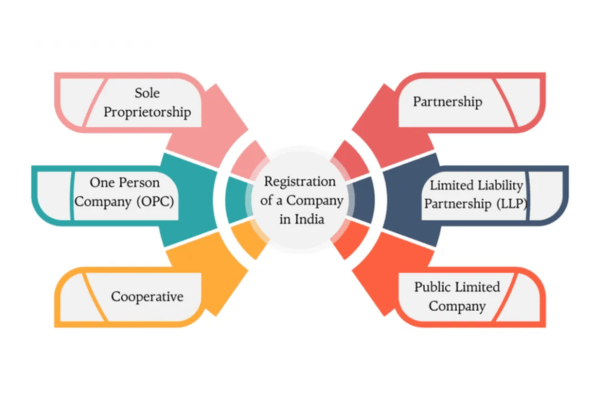
Selecting the most appropriate type of business structure in India​ is arguably one of the most important points in the life of an entrepreneur and owner of a business. The specific business structure determines the degree of legal liability, the way the firm gets taxed and prospects for growth and expansion of the firm’s operations. There are a number of business structures in India suited for various needs, giving the entrepreneurs the chance to pick the form that suits them best. This blog will assist you in understanding what types of business in India, what are some of the pros and cons, and what further factors should be considered while selecting the right structure. How Many Types of Business in India Sole Proprietorship    Among different types of businesses, sole proprietorship is the most common which is the simplest form of business structure. It is the one which is owned and operated by one Person.   Pros   Straightforward set up with little work to ensure compliance.   Freedom of choice in all decision making.   Less operational and tax expenditure for small-scale businesses.   Cons   All business debts can be claimed from the personal assets without limitation.   Opportunity for expansion and growth is limited as a single financing source is available.   All facets of management are carried out by the proprietor alone.   Partnership   Partnership is when two or more people own the business, share its responsibilities and profits.   Pros   General burden on one person is less as responsibility is shared among many.   Supply of funds and pooling of resources becomes easy.   Formation is quite easy as there are lot less regulations compared to business corporations.   Cons   Debts of the partnership have to be paid by the partners and there is no limit to the amount they contribute.   One partner can create hurdles for the other partner thereby making it difficult to sustain business.   Absence of a continual succession – a business might be terminated when one partner leaves the business.   One Person Company (OPC)   This is recommended to all the persons who find it difficult to run a business for example A One Person Company – OPC.  Pros   Personal belongings are safe from liabilities as one person is held accountable.   Ownership is in one hand which eliminates conflicts creating a smooth business flow.   Easier to raise funds as a distinct legal entity exists.   Cons   There is a restriction on the transitioning into other kinds of structures.   There is greater work to ensure compliance in businesses || compared to the sole proprietorship. More than one shareholder cannot be maintained.   Limited Liability Partnership (LLP)   A Limited Liability Partnership (LLP) combines the best features of limited liability companies and a partnership.   Pros Limited liability shield the portfolios of the partners.   A partnership leasing easier for them to source investors.   Management structure is flexible.   Cons Partnerships are cheaper to register and cost less to comply with regulations.   Limited access to third party funding.   Cooperative   A cooperative is also a member owned establishment that aims to meet the needs of all the members.   Pros Fosters collaboration of its members and sharing of profits equally.   Decisions are made through a vote.   Tax advantages/threats to cooperative societies.   Cons  Have little capacity for external finance.   Others might suffer from more inefficiency from shared ownership.   Public Limited Company   A public limited company is also the largest business form it is ideal for those who expect their companies to be funded by the public.   Pros The public shares are issued and large sums are raised.   The business continues regardless of who holds the shares due to perpetual succession. Shareholders do not have to be liable.   Cons Expect lots of complex legal requirements and follow them.   Cannot control the business anymore because the public owns shares.   Private Limited Company   A private limited company is one such type of company where most of them are willing to go with in India nowadays especially the new enterprises.   Pros They have legal recognition and limited liability.   Venture capital and private investors have an easier time financing it since there is limited liability. If a company engages in uninterrupted business activities, it maintains a distinct identity.  Cons The cost to maintain, or even start compliance is very high.  There are limits to how many and which shares can be transferred.  It requires at least two members who serve as directors and shareholders.  Joint Venture  A joint venture is an arrangement where two or more individuals, usually businesses, work together to accomplish a common goal.  Pros It allows the use of combined knowledge and resources of people involved.  It allows for the sharing of risks and responsibilities.  It is the best form of entering new markets.  Cons There will potentially be disputes between the partners.  The completion time is specific as it relates to completion of projects.  Why Selecting the Appropriate Business Form in India is Important  The correct choice of a business structure in India will influence certain key things such as the following:  Legal Responsibility  This chairman does not bear many legal responsibilities.  Taxation  The tax for other forms of businesses greatly varies from individual proprietorship allowing greater profit.  Growth Potential  The possibility of further growth is determined by the structure reached to draw investment and control resources.  Guiding Factors in Choosing the Appropriate Structure  Nature of the Business  The nature of industry and business activities determine the need of the structure.  Investment Needs  In case of structure, ensure it suits your needs whether personal funds or public shares or investors. There are all available.  Government Restrictions and Control  Certain provisions require adherence to strict regulations like those of LLPs or private limited companies.  Liability Consideration  How much risk you are willing to undertake should be weighed in case of unlimited or limited liabilities. Tax Effects  Examine the tax advantages of LLCs as compared to private limited companies in order to reduce expenses.  Management and Control Assess the degree of sharing in the decision-making process that you are comfortable with.  Future Growth and Flexibility  Select a

LLP vs Private Limited Company
Blog

LLP vs Private Limited Company: A Comparative Guide

One of the most important factors while starting a new business is choosing the most suitable legal structure. In India, Limited Liability Partnerships (LLP) and Private Limited Company (Pvt Ltd) are the most favoured options. This guide provides a thorough comparison of these two business models and delves into their characteristics, benefits, drawbacks and their appropriateness towards different businesses. What is Limited Liability Partnership (LLP)? The Limited Liability Partnership (LLP) is a unique form of business that incorporates characteristics of both partnerships and corporations. For instance, it has the best characteristics of a partnership as well as limited liability of a corporation. In India, The Limited Liability Partnerships are formed and regulated under the Limited Liability Partnership Act, 2008. This form is often used by professionals like lawyers, accountants, and consultants in practice. An LLP shields the partners from exposure of their personal property in satisfying the business debts and liabilities. In a general partnership, any one partner has to bear the brunt of the other partner’s breach in such circumstances, but in an LLP, it is not the case. Features of Limited Liability Partnerships Corporate Body LLP is a corporate individual. It is distinct of its partners and is thus treated as a corporate affiliation. It is capable of performing legal functions. It can enter into contracts, holds properties, bring and be Brought into Court, and so on. Separate Legal Entity The partners of LLP are protected from any risk arising from the partnership since the LLP itself is a recognized legal entity which is independent from its members. Therefore, the partnership can obtain loans, purchase and sell property, and so on in its own name. This guarantees that the business partners do not bear any personal risk for business-related activities. Perpetual Succession An LLP does not lose continuity as an entity merely due to the change of partners. If one of the partners goes out, retires or dies, there are no interruptions in the working of the LLP. Partnership Constitution The operation of an LLP shall be in accordance with the Limited Liability Partnership Agreement that is made and signed by the partners. The agreement states, inter alia, the functions of each partner, how the partners shall divide profits, etc. Minimum Partners An LLP can have as low as 2 designated partners with at least one being an resident of India. There is no maximum restriction over the number of partners in an LLP. Eligible Partners Individuals or corporate bodies can be the partners in an LLP. This flexibility makes it suitable for a variety of business collaboration. What is a Private Limited Company? A Private Limited Company (Pvt Ltd) is a company structure as per the Companies Act, 2013 in India. This is perhaps most suitable for entrepreneurs and small and medium enterprises. A private limited company shareholders are limited liability which provides personal security. The structure of private limited companies is quite straightforward for such a type of company has shareholders who own the company while it is directors that carry out the daily activities of the company. These companies have limited liability status, thus can be safely separated from their owners. Features of Private Limited Company Limited Liability The only obligation of the shareholders is to pay for the shares that they own and they have not paid for. In the event the company goes down, assets of shareholders and directors are left unharmed. Separate Legal Entity A Private limited company which is similar to an LLP is considered to be an independent institution from its shareholders and directors. It can acquire assets, make agreements and perform business transactions on its own. Shareholders Such a company can have between two and two hundred shareholders, and thus it has the possibility of getting more than one shareholder in order to raise funds. Directors The limit on directors in a private company is upto fifteen and the minimum is two. The directors oversee day to day management of the business. Minimum Capital Requirement Even though the Companies Act, 2013 abolished the minimum capital threshold, it is still necessary to have enough authorized capital for the private limited company to be able to carry out its operations properly. Ownership and Management The shareholding is what determines ownership while the board of directors is charged with the management. The strategic distribution of tasks increases the likelihood of role ambiguity. Transferability of Shares The shares of a private limited company can be transferred, but the process is limited in order to maintain its so-called private status. However, the transfer is usually subject to the consent of other shareholders. Compliance Requirements Some of the compliance norms to which the private entities are obligated to observe include: filing of annual returns, financial accounting statements and board meetings which make them very much regulated than the LLPs. LLP vs Pvt Ltd Advantages and Disadvantages The advantages of an LLP are as follows Ease of formation: Simple procedure for registration as well as lesser compliance requirements. Cost effective: Lower compliance and operational costs in comparison to private limited companies. Flexible management: There are no board meetings and no resolutions that have to be passed. Tax benefits: There is no tax on the distribution of dividends and profits are also taxed at a flat rate. The disadvantage of an LLP are as follows: Limited options for fundraising: They are not able to solicit equity investment from the general public or from venture capitalists. Lack of credibility: They are seen as lacking professionalism when compared to private limited companies. Profit-sharing issues: This may lead to misunderstandings amongst the partners. The advantages of a Pvt Ltd company are as follows: Better credibility: They have enhanced reputation amongst investors and financial institutions. Easy fundraising: They are able to source for equity and sell shares to investors. Limited liability: The assets of the shareholders are secure. The disadvantage of a Pvt Ltd company are as follows:  In compliance costs: It entails routine filing of returns, carrying out audits

Scroll to Top