
Rapid Consulting | MSMEs Subsidy, CLU Services, Statutory Approvals & NOC

Author name: Rapid Consulting

reverse charge mechanism under gst
Blog

Reverse Charge Mechanism Under GST – An In-depth Study

GST (Goods and Services Tax) has changed the way Indirect Taxes are Vat trolled in India, as it has retained its character of being a value added tax. One of such features is termed as Reverse Charge Mechanism (RCM). As the name suggests, a GST registered recipient rather than the supplier incurs the liability to pay tax on the provision of services. This guide will explore the details of the RCM under GST, as well as its scope and consequences for businesses. Latest Update About Reverse Charge Mechanism  The latest news about the Reverse charge mechanism can be found up here.  July 23, 2024: The GST Council has increased the list of items and services covered by RCM to include certain types of rental services and facilitation services offered by non-residents. Businesses are recommended to monitor contracts to avoid non-conformity. June 22, 2024: Changes were made to the GST Compensation Cess on e-commerce services that attract RCM making it compulsory for e-commerce operators to observe the high number of turnover for small suppliers’. June 26, 2024: A new notification has redefined the time of supply for services retired under RCM thereby assisting ease tax compliance for registered taxpayers. What is Reverse Charge Mechanism?  The Reverse Charge Mechanism (RCM) is a tax regulation process with the essence of causing the recipient rather than the supplier to pay tax as a consequence of a taxable supply. Unlike the forward charge mechanism where the supplier is responsible for tax payment, the recipient of the taxable supply is liable to make tax payment directly to the government in RCM.  What is Reverse Charge Mechanism in GST? RCM in GST refers to any process in RCM that is applicable to certain designated good or services notified by the government in the country’s GST policy. It is appropriate for dealing with unregistered suppliers and imports and some specified services. This clause provides provision for appropriate tax collection and assists in the controlling mechanism of tax evasion of the unorganized sectors in the economy. When is Reverse Charge under GST Applicable?  Reverse charge under GST is applicable in the following scenarios:  Unregistered Suppliers: When a registered recipient procures goods or services from an unregistered supplier.  Specified Categories: On goods and services listed in the government’s notification, such as legal services and rent-a-cab services.  Import of Goods/Services: Tax liability falls on the importer.  E-commerce Services: Applicable when services are provided through an e-commerce operator.  RCM Who is Liable to pay the GST?  RCM places the liability of tax payments on the recipient of goods and services and not the supplier. When, for example, a business expands its scope to provide legal services through advocates, it’s the responsibility of that business as the purchaser to pay the GST.   Different Types of Reverse Charges Under GST   Forward Charge   The supplier collects GST from the recipient and manages to remit it to the government in this traditional model.  Backward Charge (Reverse Charge)   In this case, the payer of service or goods bypasses the supplier and settles the government directly with GST.  RCM Provisions Under GSTR Forms – GSTR-1 and GSTR-2   GSTR-1: Invoices subjected to RCM must be revealed by the suppliers.  GSTR-2: Where purchase has been made and self-assessed liability to RCM GST has been incurred must be submitted by contacts. Time of Supply of Goods and Services under RCM Time of Supply of Goods under RCM Receipt of the goods Payment made Invoice issued 30 days ago Time of Supply for Services under RCM Receipt of payment Invoice issues 60 days ago The earlier of these dates will determine the time of supply of both goods and services. What Are the Registration Requirements Under RCM? Threshold for minimum requirement RCM is applicable even to a supplier who is unregistered but has gone beyond the threshold limit given. Supplier vs Recipient The recipient is required to be registered under GST in order to be compliant to the RCM provisions irrespective of the status of the supplier. Composition Dealers Composition dealers do not want RCM as they will not be able to claim the input tax credits. GST Compensation Cess Services covered under the scopes of GST Compensation Cess are covered under RCM. E-commerce Services RCM applies in respect of supplies directed by unregistered vendors by e-commerce operators. Who Needs To Pay GST Under RCM RCM works on: Paid by registered companies who buy from unpaid suppliers. Those Paying Taxes Within Goods or Services’ Importations. Individuals who are provided with certain specified services e.g. legal services, security services, sponsorships etc. Positive Impacts of RCM Improved Compliance and fair competition RCM guarantees fairness by making tax collection from the unorganised sector a formality. Cost Saving through Tax Credits Acknowledgement of input tax paid under RCM Methods can also help the recipients to lower their overall tax burden. Challenges of RCM Increase in Compliance Cost Under RCM, businesses are required to handle more paperwork and filing requirements leading to increased overhead costs. Complicated Document Management RCM invoice and payment substantiation require logs making bookkeeping much more difficult. Why We Need to Consult Professionals   To understand the complexities of the reverse charge mechanism under GST, one has to comprehend the law and its changes from time to time. RCM applicability, tax liability, and documentation requirements are examples of areas in which an expert practitioner can advise. Getting these professionals assists them in submitting appropriate GST returns, obtaining the necessary input tax credits, and avoiding penalties for non-compliance. It is critical to note that these RCM provisions under GST keep changing which could be quite overwhelming for businesses and hence, it is prudent to seek professional assistance like: Rapid Consulting for seamless business conduct and legal compliance. Conclusion The implementation of the Reverse Charge Mechanism under the GST provisions plays an integral role in achieving tax compliance and accountability. Any business firm needs to be alive to the latest RCM provisions to avoid infringing the RCM requirements. It has been established that indeed even though

Change In Land Use (Approval)
Approvals

Change in Land Use (CLU)

Rapid Consulting streamlines your Change in Land Use process, expertly guiding you through approvals and ensuring your project complies with regulations, unlocking the full potential of your land. CHANGE IN LAND USE – About the service Rapid Consulting specializes in providing expert services for facilitating change in land use. Let the team of experienced professionals offer comprehensive assistance to clients seeking to navigate the intricacies of change in land use regulations and policies. Our services encompass a spectrum of offerings, including · Regulatory Analysis: Conducting thorough assessments of change in land use regulations and zoning ordinances to identify opportunities for optimization. · Feasibility Studies: Conducting detailed feasibility studies to evaluate the viability of proposed land use changes, considering factors such as market demand, economic impact, and environmental considerations. · Stakeholder Engagement: Facilitating meaningful engagement with stakeholders, including local communities, government agencies, and advocacy groups, to ensure that proposed land use changes align with community needs and priorities. · Planning and Design: Providing innovative planning and design solutions tailored to meet the unique requirements of each project, optimizing land utilization while promoting sustainable development principles. · Permitting and Regulatory Compliance: Guiding clients through the permitting process, navigating regulatory requirements and securing necessary approvals for proposed land use changes. · Environmental Impact Assessment: Conducting thorough environmental impact assessments to evaluate the potential ecological consequences of proposed land use changes and identify mitigation measures to minimize adverse effects. · Legal Support: Offering legal support and advocacy services to clients facing challenges or opposition to proposed land use changes, ensuring compliance with applicable laws and regulations. Benefits · Save Time & Resources: Focus on your core business activities while we handle the intricate licensing process. · Minimize Risks & Delays: Our expertise guides you through potential pitfalls, ensuring a smooth application and approval journey. · Maximize Approval Chances: Increase your chances of success with our proven track record and in-depth understanding of licensing requirements. · Gain Peace of Mind: Operate with confidence, knowing your project is legally compliant and authorized for commercial development. Read More Articles: Interest Subsidy Scheme for Textile MSMEs

Interest Subsidy Scheme for Textile MSMEs
Subsidies

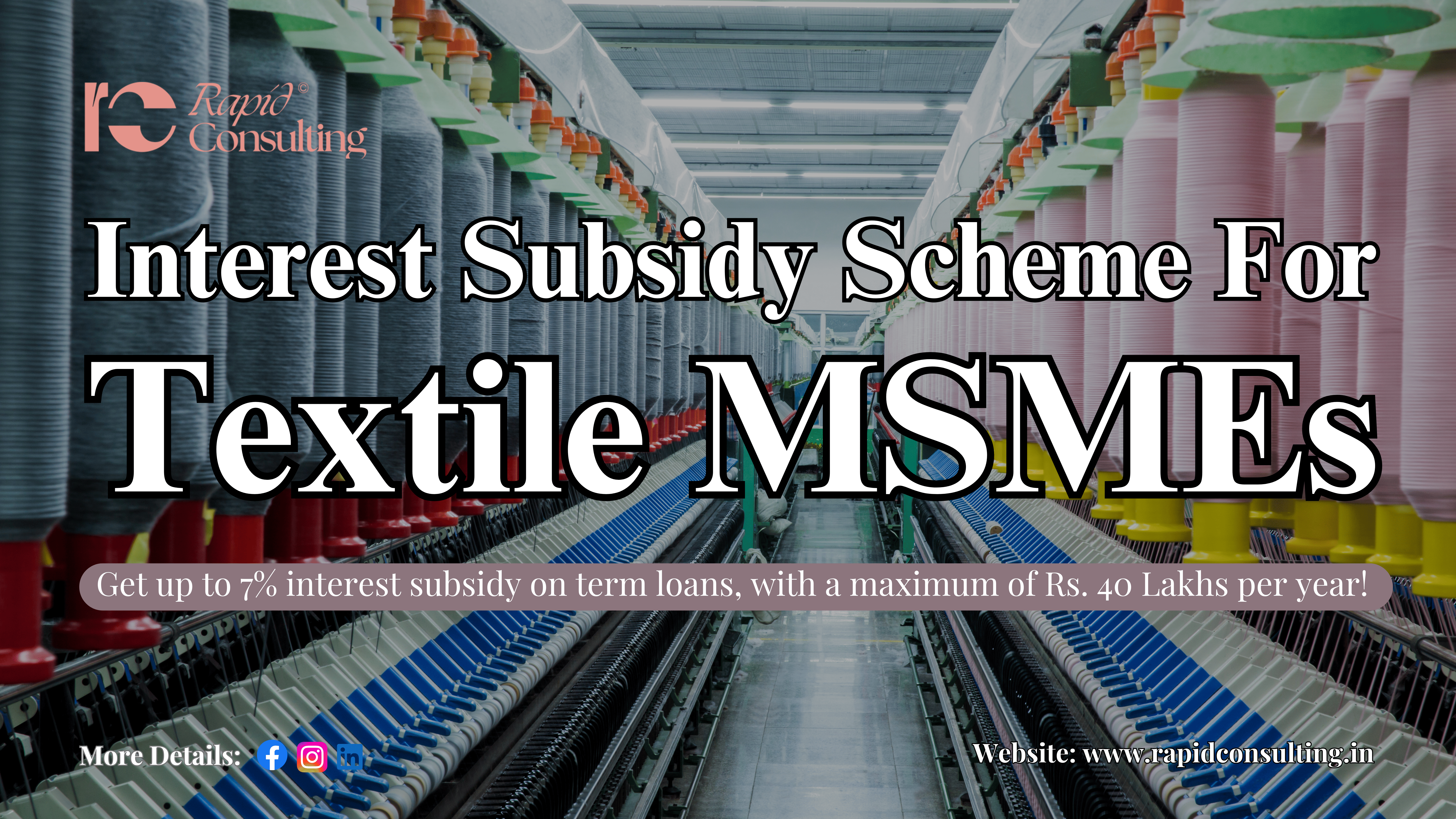
Interest Subsidy Scheme for Textile MSMEs

Interest Subsidy Scheme for Textile MSMEs aimed at supporting textile Micro, Small, and Medium Enterprises (MSMEs) across the state. This initiative is designed to lower the cost of financing for textile businesses by subsidizing the interest on term loans. This strategic move is intended to foster the growth and expansion of textile enterprises by making financial resources more affordable. Interest Subsidy Scheme for Textile MSMEs The primary goal of the scheme is to reduce the financial burden on textile MSMEs by providing an interest subsidy on term loans.The assistance varies by the category of the block: B category blocks: 6% subsidy, up to INR 20 lakh per year. C category blocks: 7% subsidy, up to INR 30 lakh per year. D category blocks: 7% subsidy, up to INR 50 lakh per year. These subsidies are available for a period of seven years and apply to new projects as well as expansion, diversification, and modernization of existing projects. Eligibility Criteria for Interest Subsidy Scheme for Textile MSMEs Eligible enterprises are those that engage in various textile-related activities, from ginning and pressing to technical textiles and apparel manufacturing. To qualify, enterprises must:· Be registered with Udyam and have a Haryana Udyam Memorandum.· Have availed a term loan from a recognized financial institution after the commencement of the scheme.· Being commercial production and not listed as a non-performing asset (NPA) with any financial institution. Application and Documentation Applications must be submitted through the Directorate of MSME’s web portal within three months of the financial year-end for which the subsidy is claimed. Required documents include the Udyam Registration Certificate, proof of term loan disbursement, and financial statements among others. Procedure and Time Limits for Claims The scheme outlines a clear process handled by the District MSME Centers, where applications are scrutinized for eligibility and compliance. Enterprises can appeal against any adverse decisions to the Director General of MSMEs or the Administrative Secretary, Industries & Commerce, ensuring that there is a fair process for addressing grievances. Competent Authority and Sanctioning Process The Additional Director of the Department of Industries and Commerce is designated as the competent authority for the sanctioning of subsidies, ensuring a centralized and streamlined process for the evaluation and approval of applications. Penalties and Recourse Strict penalties, including the repayment of subsidies with interest, are imposed for any misrepresentation or fraud in accessing the scheme. This is intended to ensure that only deserving enterprises benefit from the scheme and that the funds are used appropriately. Conclusion The Interest Subsidy Scheme is a significant initiative by the Haryana Government to promote sustainable growth in the textile sector by making credit more accessible and affordable. By reducing the cost of borrowing, the scheme aims to encourage investment in the textile industry, thereby boosting job creation and economic development in the state. Rapid Consulting’s Role in Facilitating the Process Rapid Consulting provides specialized assistance to textile MSMEs in Haryana under the ‘Interest Subsidy Scheme for Textile MSMEs’ as outlined in the Haryana Aatma Nirbhar Textile Policy 2022-25. They assist enterprises by clarifying the scheme’s eligibility requirements, aiding in the preparation and submission of applications, and ensuring that enterprises comply with the guidelines to maximize financial benefits through interest subsidies on term loans for various textile-related projects. Impact of the Scheme on Industrial Growth The scheme significantly boosts Haryana’s textile sector by providing interest subsidies to reduce the financial burden on textile MSMEs engaging in new projects or expanding, diversifying, and modernizing existing operations. This financial support enables textile enterprises to invest more aggressively in innovative and high-value textile solutions, thereby driving industrial growth neuroquiet, enhancing competitiveness, and supporting sustainable economic development in the region. Future Prospects and Enhancements Looking ahead, potential enhancements to the scheme might include expanding the eligibility to include additional forms of textile-related activities, increasing the subsidy caps to accommodate larger projects, or extending the duration of the scheme to provide long-term support. Additionally, linking this subsidy more closely with other state or national economic development initiatives could further enhance its impact, helping to create a more robust textile sector in Haryana. Target Sectors in Haryana The “Interest Subsidy Scheme for Textile MSMEs” is part of the Haryana Aatma Nirbhar Textile Policy 2022-25. It supports a wide range of textile activities such as spinning, weaving, dyeing, processing, technical textiles, and garment manufacturing across Haryana. This scheme aims to bolster investments and technological advancements in the textile industry by reducing the financial burden of interest on loans. Eligibility for Existing Businesses and New Ventures Eligibility includes new, existing, and expanding textile enterprises that have obtained a Udyam Registration Certificate (URC) and Haryana Udyam Memorandum (HUM). These enterprises must have availed term loans from financial institutions after the policy’s notification and be in regular production without being classified as non-performing assets (NPAs). Integration with Other Subsidies and Incentives This scheme integrates with the broader objectives of the Haryana Enterprises and Employment Policy-2020, aiming to enhance the competitiveness of textile enterprises while promoting sustainable industrial growth within the state. Application Process: Applications must be submitted through the MSME web portal within three months from the end of the financial year or after completing the relevant financial transactions. The process is managed by the district MSME center, ensuring adherence to the policy’s guidelines and verification of the operational status of the enterprise. Geographical Preferences in Haryana: The financial assistance varies based on the location of the textile unit within the state. Higher subsidies are provided in less developed ‘D’ category blocks, followed by ‘C’ and ‘B’ categories, encouraging equitable economic development across different regions. Summary The Interest Subsidy Scheme for Textile MSMEs offers significant financial incentives to textile MSMEs across Haryana, promoting the adoption of advanced technologies and practices. By subsidizing the interest on term loans, the scheme helps businesses manage costs more effectively, contributing to the state’s economic and environmental sustainability goals. How to Reach Us ? Website: Visit our official website for detailed information, and service offerings, and to schedule an online consultation. Direct Contact: Call us at +91-9467248028 / 9416506136

Scroll to Top